

The Light Switch

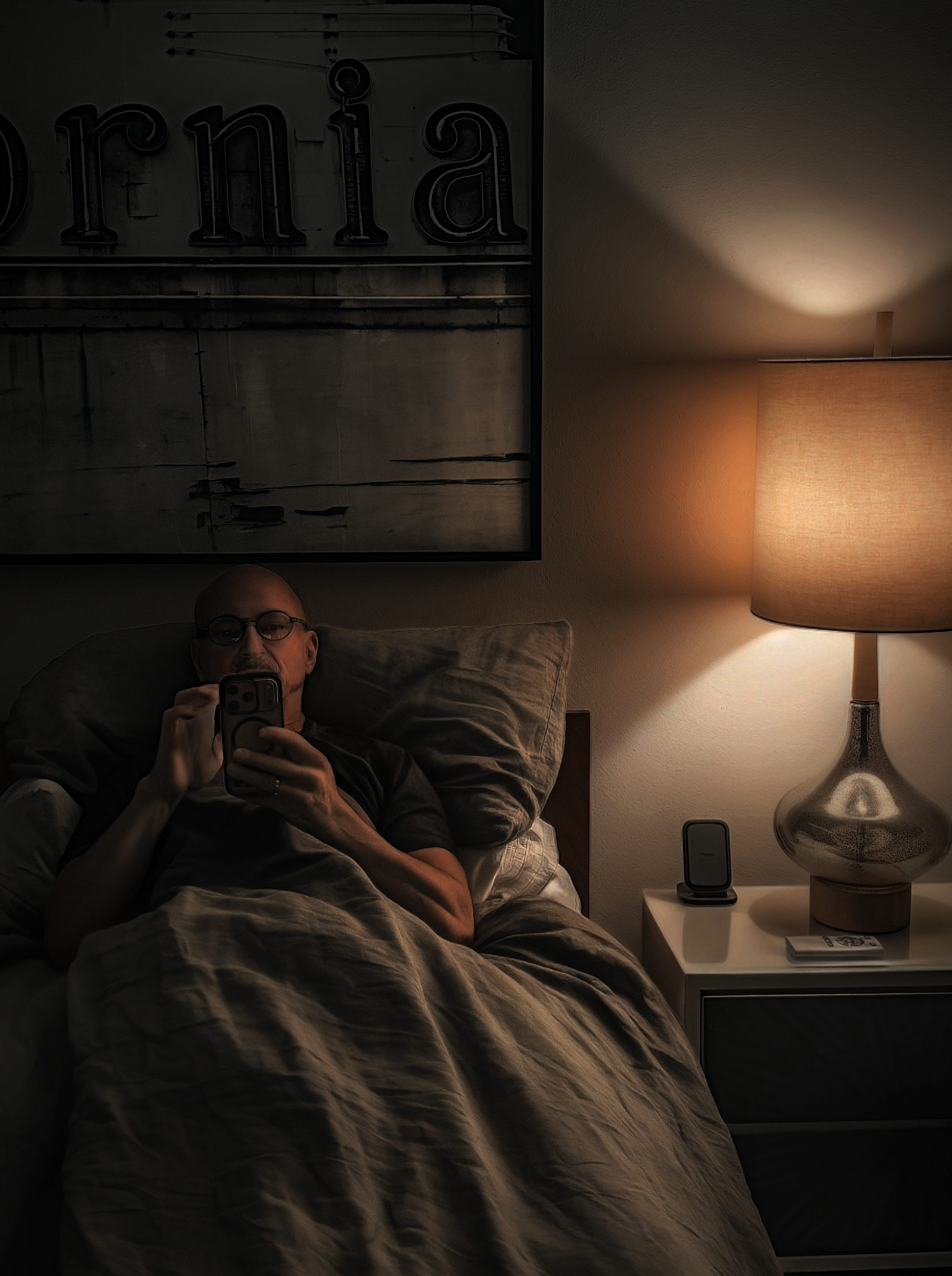
My husband will lie in bed with a perfectly functional light switch six inches from his hand…
…and still spend six full minutes trying to turn the lamp off with his phone.
Not casually either.
Focused. Determined. Like a NASA engineer attempting re-entry.
The app freezes.
Bluetooth disconnects.
The Wi-Fi bulb disappears.
He sighs.
Refreshes.
Tries again.
At one point the room stays aggressively lit like the lamp is punishing both of us.
He will restart the app before he will move his arm four inches.
Meanwhile, the actual lamp switch sits there beside him calm as hell.
Stable. Reliable. Like, “I have literally had one job since I was invented in 1879.”
Just quietly whispering:
You could just touch me.
But he won’t.
This is a man who can install electrical, do plumbing, create like a chef, and arrange flowers better than most florists… yet cannot emotionally surrender to a bedside lamp.
And honestly? I don’t think this is about the lamp.
Somewhere along the way, convenience stopped being about ease and started becoming about control.
Not physical control. System control.
Think about what lives in our phones. It’s not a device anymore. It’s the command center for our entire lives.
Everything routes through it:
lights,
music,
temperature,
communication,
identity,
work,
memory,
validation,
escape.
So when the lamp won’t cooperate, he’s not just troubleshooting a bulb. He’s defending the system. Reaching for the switch feels like admitting the whole setup has a crack in it.
The brain doesn’t love that.
Cognitive scientists call it automation bias — once you’ve built a pathway around a system, your brain keeps routing through it even when a simpler option exists. Switching actually costs more neurological energy than staying inside the familiar one.
Which is funny, because from the outside it looks wildly inefficient.
Researchers like Karl Friston have argued that the brain is essentially a prediction machine — constantly running models, constantly trying to confirm them. Once a behavior gets wired in, we re
peat it almost automatically. Not because it’s working. Because it’s known.
So he’s not being irrational. He’s being deeply, exhaustingly human.
Watching someone spend six minutes avoiding one second of effort feels spiritually important somehow. Because human beings do this constantly.
We stay in complicated emotional systems instead of having direct conversations. We create elaborate workflows instead of solving the actual problem. We spend twenty minutes searching for the perfect productivity app instead of starting the task.
We overthink instead of reaching for the obvious thing sitting beside us.
And watching him battle that lamp feels a little like watching humanity right now.
Sometimes I lose patience and want to tell him the lamp is right there.
And then I catch myself.
Because there are things sitting right in front of me that I keep avoiding too. Conversations I route around. Clarity I defer. Simple moves I complicate because the complicated version feels more like I’m doing something.
We have more tools than ever.
More systems.
More optimization.
More connectivity.
And yet sometimes we seem farther away from the world right in front of us than we’ve ever been.
Maybe part of being human now is remembering that not every problem needs an interface.
Sometimes the light switch is enough.
I’m still working on knowing the difference.
I love this Paul!! So true